

Money & Economics
- Thread starter bigredfish
- Start date
You are using an out of date browser. It may not display this or other websites correctly.
You should upgrade or use an alternative browser.
You should upgrade or use an alternative browser.


US Consumer Sentiment officially falls to its lowest level on record in data going back to 1952, down another -10% last month.
Consumers now see inflation rising to 4.8% over the next 12 months.
This puts the Consumer Sentiment index down -21% since February 2026, before the Iran War.
Not even the 1980s saw Consumer Sentiment this low.
Consumers now see inflation rising to 4.8% over the next 12 months.
This puts the Consumer Sentiment index down -21% since February 2026, before the Iran War.
Not even the 1980s saw Consumer Sentiment this low.
Last edited:

mat200
IPCT Contributor
- Jan 17, 2017
- 18,922
- 31,644
This seems to be what they're doing.
House of cards...
100 % house of cards .. when the pullback happens gonna hurt those who think stonks only go up.
Still waiting for ssd and hdds prices ti get affordable again

100 % house of cards .. when the pullback happens gonna hurt those who think stonks only go up.
Still waiting for ssd and hdds prices ti get affordable again
I can’t find it right now, but saw a piece where China is about to flood the market with cheap ssd/ memory..?

I wonder if it will have it's own hidden spyware chip embedded....I can’t find it right now, but saw a piece where China is about to flood the market with cheap ssd/ memory..?
remember 2018?
Attachments


I wonder if it will have it's own hidden spyware chip embedded....
remember 2018?
LOL
YES! But at least our information will go to Beijing instead of DC. Lesser of two evils
Markets no longer operate on fundamentals. Valuations are fake, the markets are IMHO dead. Its simply a big Ponzi scheme now and they're not really even trying to hide it.
The question is really simple: How long can they get away with it?
=============
 www.zerohedge.com
Politicians will scream at each other all day over taxes, healthcare, immigration, tariffs, student loans, climate policy, or whatever outrage is currently driving engagement on cable news and social media. But the second the conversation turns toward monetary policy, toward the machinery of money creation itself, the room suddenly gets very quiet.
That’s because monetary policy has quietly become the single most powerful force reshaping wealth distribution in modern America. And unlike the endless partisan theater surrounding fiscal policy, monetary intervention oddly enjoys remarkable bipartisan support.
Republicans and Democrats may pretend to be existential enemies on television, but when it comes to flooding the financial system with dollars, both parties reliably fall into line. And that support is precisely why this topic is politically radioactive: once people understand how the system works, the illusion of two competing economic ideologies starts to collapse. Republicans want less spending, Democrats want higher taxes…but both parties want the Fed to keep printing dollars.
.....The Federal Reserve’s balance sheet exploded from under $1 trillion before 2008 to nearly $9 trillion after the pandemic era. Like nearly every government “emergency” program in history, the temporary measure never truly disappeared, it simply normalized, expanded, and embedded itself deeper into the system. It culminated in Neel Kashkari taking to national television to let the world know the Fed has “infinite” cash.
Which is to say…the old rules are dead.
Historical valuation metrics increasingly feel meaningless because markets are no longer functioning inside anything resembling a closed system governed by organic price discovery and economic fundamentals. Investors used to rely on earnings multiples, historical averages, bond yields, and economic cycles because those metrics assumed markets were constrained by actual capital and relatively stable money supply growth.
Now we operate inside a permanently distorted financial system where trillions of dollars can be electronically created and injected into markets whenever instability appears. The market is no longer primarily driven by productivity or efficient allocation of capital. It is driven by liquidity. Price discovery has been replaced by intervention dependency and risk has been socialized while gains remain privatized.
And every time markets threaten to correct naturally, policymakers intervene to ensure asset prices do not fall far enough to inflict meaningful pain on the people who own the overwhelming majority of financial assets. And the consequences of this have been staggering.
While both parties bitch and moan about affordability, protecting the middle and lower class, and “equity”, one of the clearest signs of this Fed-created distortion is the explosive growth of the ultrawealthy class. According to The Wall Street Journal, there are now roughly 430,000 American households worth more than $30 million, including approximately 74,000 households worth over $100 million. The growth of these groups has dramatically outpaced overall population growth over the past several decades.
In other words, Fed policy, blessed by both political parties, is widening the wealth inequality gap both political parties claim to fighting against. This staggering chart shows the result of endless QE: the rich get richer…which would normally be fine with me, I’m a capitalist…except the top 1% are getting richer faster and at the expense of the middle and lower class’ loss purchashing power. When it comes to purchasing power, we are literally taking from the poor, and giving to the rich.

And this is the direct mathematical outcome of an economic system designed to inflate asset prices continuously. The Wall Street Journal cited research showing that the inflation-adjusted wealth of the top 0.1% has increased more than thirteen fold over the past fifty years. Meanwhile, the bottom half of the country spent decades struggling merely to maintain positive net worth.
Think about how insane that divergence really is. Fed policy has caused the wealth of the rich to escape into another dimension entirely while much of the country got buried under inflated housing costs, inflated healthcare, inflated tuition, inflated insurance, inflated food prices, and stagnant purchasing power. It’s a policy that directly benefits the “haves” and disproportionately burdens the “have nots” (think about owning a house while prices rise, versus trying to a buyer of your first house while prices rise).
Nearly 72% of the wealth held by the top 0.1% consists of stocks, mutual funds, and private businesses — precisely the assets supercharged by quantitative easing and artificially suppressed interest rates, the piece notes.
This is the hidden engine underneath modern inequality.
When central banks flood the system with liquidity, the money does not magically disperse evenly across society. It enters through banks, financial institutions, government spending channels, debt markets, and asset purchases. The first recipients of newly created money benefit before inflation fully spreads through the broader economy.
By the time ordinary people feel the effects, prices have already risen. The wealthy own appreciating assets. The middle and lower classes primarily own wages and cash. And wages are always the last thing to adjust.
So while asset holders watch their net worth explode upward, ordinary families experience the opposite reality: homes become unattainable, groceries spike, savings accounts become meaningless, and generations are pushed further away from financial stability.
The question is really simple: How long can they get away with it?
=============
The Devil Neither Political Party Will Name
The Devil Neither Political Party Will Name<!-- --> | ZeroHedge
ZeroHedge - On a long enough timeline, the survival rate for everyone drops to zero
www.zerohedge.com
Politicians will scream at each other all day over taxes, healthcare, immigration, tariffs, student loans, climate policy, or whatever outrage is currently driving engagement on cable news and social media. But the second the conversation turns toward monetary policy, toward the machinery of money creation itself, the room suddenly gets very quiet.
That’s because monetary policy has quietly become the single most powerful force reshaping wealth distribution in modern America. And unlike the endless partisan theater surrounding fiscal policy, monetary intervention oddly enjoys remarkable bipartisan support.
Republicans and Democrats may pretend to be existential enemies on television, but when it comes to flooding the financial system with dollars, both parties reliably fall into line. And that support is precisely why this topic is politically radioactive: once people understand how the system works, the illusion of two competing economic ideologies starts to collapse. Republicans want less spending, Democrats want higher taxes…but both parties want the Fed to keep printing dollars.
.....The Federal Reserve’s balance sheet exploded from under $1 trillion before 2008 to nearly $9 trillion after the pandemic era. Like nearly every government “emergency” program in history, the temporary measure never truly disappeared, it simply normalized, expanded, and embedded itself deeper into the system. It culminated in Neel Kashkari taking to national television to let the world know the Fed has “infinite” cash.
Which is to say…the old rules are dead.
Historical valuation metrics increasingly feel meaningless because markets are no longer functioning inside anything resembling a closed system governed by organic price discovery and economic fundamentals. Investors used to rely on earnings multiples, historical averages, bond yields, and economic cycles because those metrics assumed markets were constrained by actual capital and relatively stable money supply growth.
Now we operate inside a permanently distorted financial system where trillions of dollars can be electronically created and injected into markets whenever instability appears. The market is no longer primarily driven by productivity or efficient allocation of capital. It is driven by liquidity. Price discovery has been replaced by intervention dependency and risk has been socialized while gains remain privatized.
And every time markets threaten to correct naturally, policymakers intervene to ensure asset prices do not fall far enough to inflict meaningful pain on the people who own the overwhelming majority of financial assets. And the consequences of this have been staggering.
While both parties bitch and moan about affordability, protecting the middle and lower class, and “equity”, one of the clearest signs of this Fed-created distortion is the explosive growth of the ultrawealthy class. According to The Wall Street Journal, there are now roughly 430,000 American households worth more than $30 million, including approximately 74,000 households worth over $100 million. The growth of these groups has dramatically outpaced overall population growth over the past several decades.
In other words, Fed policy, blessed by both political parties, is widening the wealth inequality gap both political parties claim to fighting against. This staggering chart shows the result of endless QE: the rich get richer…which would normally be fine with me, I’m a capitalist…except the top 1% are getting richer faster and at the expense of the middle and lower class’ loss purchashing power. When it comes to purchasing power, we are literally taking from the poor, and giving to the rich.

And this is the direct mathematical outcome of an economic system designed to inflate asset prices continuously. The Wall Street Journal cited research showing that the inflation-adjusted wealth of the top 0.1% has increased more than thirteen fold over the past fifty years. Meanwhile, the bottom half of the country spent decades struggling merely to maintain positive net worth.
Think about how insane that divergence really is. Fed policy has caused the wealth of the rich to escape into another dimension entirely while much of the country got buried under inflated housing costs, inflated healthcare, inflated tuition, inflated insurance, inflated food prices, and stagnant purchasing power. It’s a policy that directly benefits the “haves” and disproportionately burdens the “have nots” (think about owning a house while prices rise, versus trying to a buyer of your first house while prices rise).
Nearly 72% of the wealth held by the top 0.1% consists of stocks, mutual funds, and private businesses — precisely the assets supercharged by quantitative easing and artificially suppressed interest rates, the piece notes.
This is the hidden engine underneath modern inequality.
When central banks flood the system with liquidity, the money does not magically disperse evenly across society. It enters through banks, financial institutions, government spending channels, debt markets, and asset purchases. The first recipients of newly created money benefit before inflation fully spreads through the broader economy.
By the time ordinary people feel the effects, prices have already risen. The wealthy own appreciating assets. The middle and lower classes primarily own wages and cash. And wages are always the last thing to adjust.
So while asset holders watch their net worth explode upward, ordinary families experience the opposite reality: homes become unattainable, groceries spike, savings accounts become meaningless, and generations are pushed further away from financial stability.
The SpaceX IPO is the most brazen retail fleecing in modern market history.
NASDAQ has REWRITTEN the index rules specifically for this listing. The 10% minimum free float requirement: gone. The 3 to 12 month seasoning period before index inclusion: cut to 15 trading days. Companies with small floats can now be weighted at 3x their actual float.
Translation: every passive index fund, every 401k, every pension is about to be force-fed SPCX whether they want it or not.
And what exactly are they buying?
Class A shares carrying ONE vote each, while Musk holds 93.6% of the Class B super voting shares at TEN votes each. That gives him 85.1% of voting power on a 42% economic interest. He cannot be outvoted. He cannot be removed. CEO, CTO and board chairman simultaneously.
For reference: Zuckerberg controls 61% of Meta. Buffett 35% of Berkshire. Musk: 85.1%.
SpaceX is also claiming "controlled company" status, exempting it from needing a majority of independent directors. Shareholders waive the right to a jury trial. They waive the right to class actions. Mandatory arbitration only, courtesy of an SEC rule change pushed through on a party line vote last September.
$1.75 trillion valuation. $80 billion raise. Largest IPO in history.
The rules of the game were quietly rewritten so one man could extract maximum capital from retail while answering to no one.
NASDAQ has REWRITTEN the index rules specifically for this listing. The 10% minimum free float requirement: gone. The 3 to 12 month seasoning period before index inclusion: cut to 15 trading days. Companies with small floats can now be weighted at 3x their actual float.
Translation: every passive index fund, every 401k, every pension is about to be force-fed SPCX whether they want it or not.
And what exactly are they buying?
Class A shares carrying ONE vote each, while Musk holds 93.6% of the Class B super voting shares at TEN votes each. That gives him 85.1% of voting power on a 42% economic interest. He cannot be outvoted. He cannot be removed. CEO, CTO and board chairman simultaneously.
For reference: Zuckerberg controls 61% of Meta. Buffett 35% of Berkshire. Musk: 85.1%.
SpaceX is also claiming "controlled company" status, exempting it from needing a majority of independent directors. Shareholders waive the right to a jury trial. They waive the right to class actions. Mandatory arbitration only, courtesy of an SEC rule change pushed through on a party line vote last September.
$1.75 trillion valuation. $80 billion raise. Largest IPO in history.
The rules of the game were quietly rewritten so one man could extract maximum capital from retail while answering to no one.

The CEO of BlackRock, Larry Fink, admits that the trillions of dollars being used to build data centers and power grids will come from ordinary people’s savings accounts and pension funds, and says it is mandatory.
He says America needs trillions in AI infrastructure spending, and that people will be forced to “invest” in it.
“Much of this will come from savings accounts and pension accounts.”
He says America needs trillions in AI infrastructure spending, and that people will be forced to “invest” in it.
“Much of this will come from savings accounts and pension accounts.”
I can’t find it right now, but saw a piece where China is about to flood the market with cheap ssd/ memory..?
...As I was saying...
China Begins Flooding The Market With DRAM And NAND Memory Chips
China Begins Flooding The Market With DRAM And NAND Memory Chips<!-- --> | ZeroHedge
ZeroHedge - On a long enough timeline, the survival rate for everyone drops to zero
www.zerohedge.com
mat200
IPCT Contributor
- Jan 17, 2017
- 18,922
- 31,644
Why Japan isn’t broke yet
Money & Macro
This video explores the counterintuitive financial state of Japan, which holds the world's highest government debt-to-GDP ratio (over 220%) yet maintains low interest rates and avoids traditional debt crises. The central thesis is that analysts often look at the wrong numbers by focusing only on gross debt instead of net debt.
Money & Macro
This video explores the counterintuitive financial state of Japan, which holds the world's highest government debt-to-GDP ratio (over 220%) yet maintains low interest rates and avoids traditional debt crises. The central thesis is that analysts often look at the wrong numbers by focusing only on gross debt instead of net debt.
Key Takeaways:
- The Net Debt Perspective (0:43 - 2:40): While Japan's official debt is massive, the government (including the central bank and public pension funds) holds a vast portfolio of financial assets, roughly 192% of GDP. When you net these assets against liabilities, Japan’s debt is significantly lower than that of many Western nations.
- The "Hedge Fund" Government (3:11 - 16:31): The Japanese government effectively operates like a massive hedge fund. Historically, it acted as a national bank, but as the population aged and growth stagnated, it shifted to a "carry trade" model: borrowing in yen at ultra-low interest rates to invest in higher-yielding foreign assets (like US Treasury bonds).
- The Role of Luck (12:12 - 14:52): The strategy succeeded largely because the yen significantly depreciated over the last decade, increasing the value of foreign-denominated assets when converted back into yen. This helped reduce net debt from 118% in 2012 to 77% today.
Risks and Future Outlook (
- Geopolitics: A deglobalized world could threaten Japan’s ability to hold or access foreign assets.
- Inflation: As Japan's population ages further, increased consumption and a weakening yen may drive domestic inflation. If the Bank of Japan is forced to raise interest rates to combat inflation, the "hedge fund" model may become unsustainable, as higher borrowing costs would hurt the government’s bottom line.
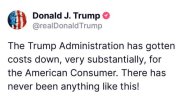
Trump's tariffs caused corporate bankruptcies to hit a 15-year high, 717 companies filed in 2025 alone.
MAGA!
MAGA!